1/1
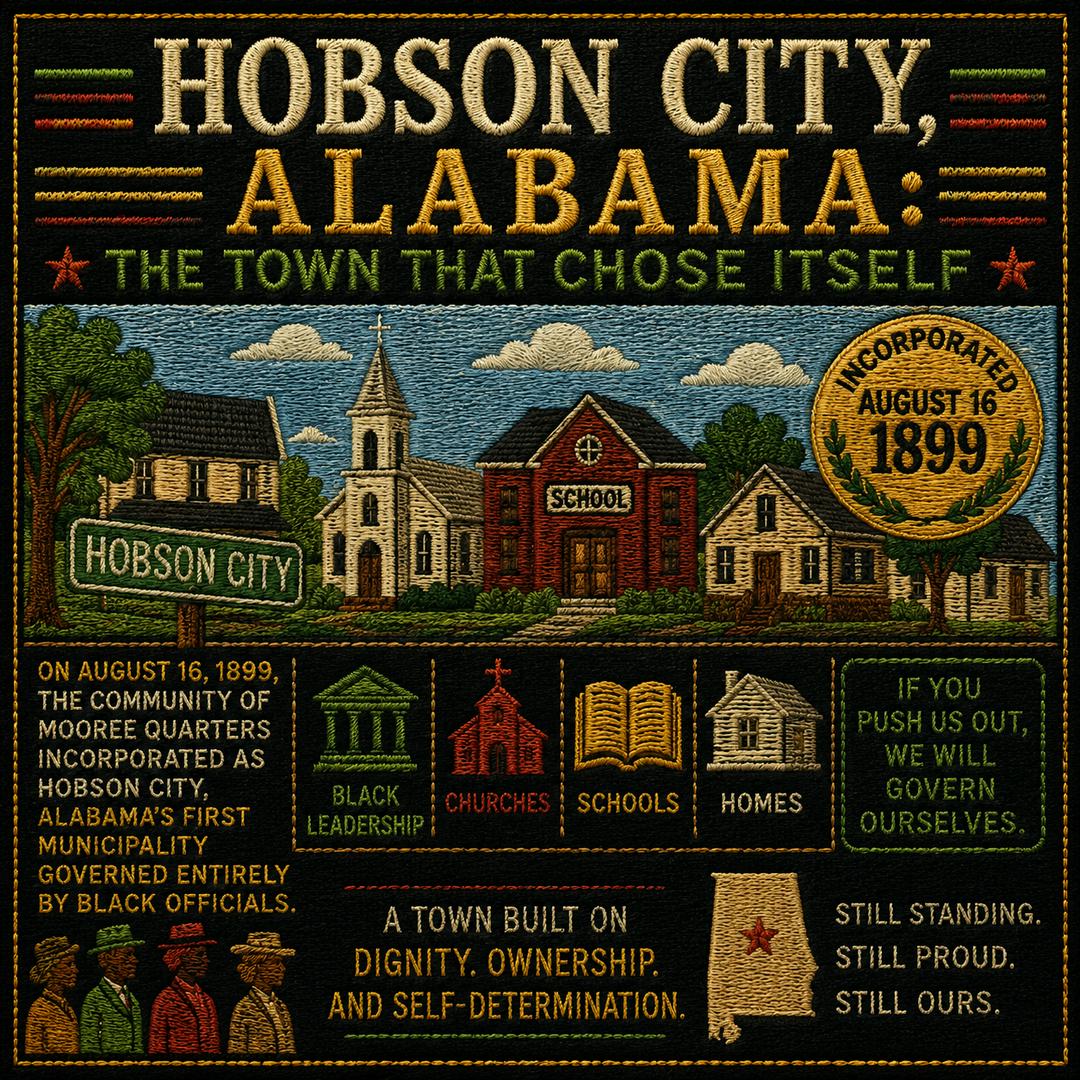
Hobson City, Alabama: The Town That Chose Itself Before it became Hobson City, the area was known as Mooree Quarters, a Black community near Oxford, Alabama. Black residents lived there, worked there, voted there, paid taxes there, and helped shape local elections. But that political power made some white leaders uncomfortable. According to the town’s history, Black voters were often a controlling factor in elections, and Mooree Quarters was eventually separated from Oxford. So the people of Mooree Quarters did something powerful. They organized. On August 16, 1899, the community incorporated as Hobson City, becoming Alabama’s first municipality governed entirely by Black officials and the second Black-governed municipality in the United States after Eatonville, Florida. At a time when Black political power was being attacked across the South, Hobson City became a statement in map form. It said: if you push us out, we will govern ourselves. The town built its own civic life, including leadership, schools, churches, homes, and community institutions. It was not just a place where Black people lived. It was a place where Black people led. That matters because history often talks about what was taken from Black communities, but Hobson City reminds us what was built in spite of it. Land was not just land. A town was not just a town. It was protection. It was dignity. It was ownership. It was a way of saying, “We belong somewhere, even when the world keeps trying to move the line.” Hobson City still exists today in Calhoun County, Alabama. And the question is simple: Why were so many of us taught about cities that excluded us, but not the towns we built when exclusion tried to erase us? #BlackHistory #HiddenHistory #HobsonCity #AlabamaHistory #BlackTowns #ForgottenHistory #AmericanHistory
Hobson City, Alabama • 8 days ago

Savannah
...and is a thriving city.. Mayor Alberta McCrory
7d
Oxford, AL
Reply
1
More comments ...
write a comment...