Tag Page BlackHistory

#BlackHistory
LataraSpeaksTruth

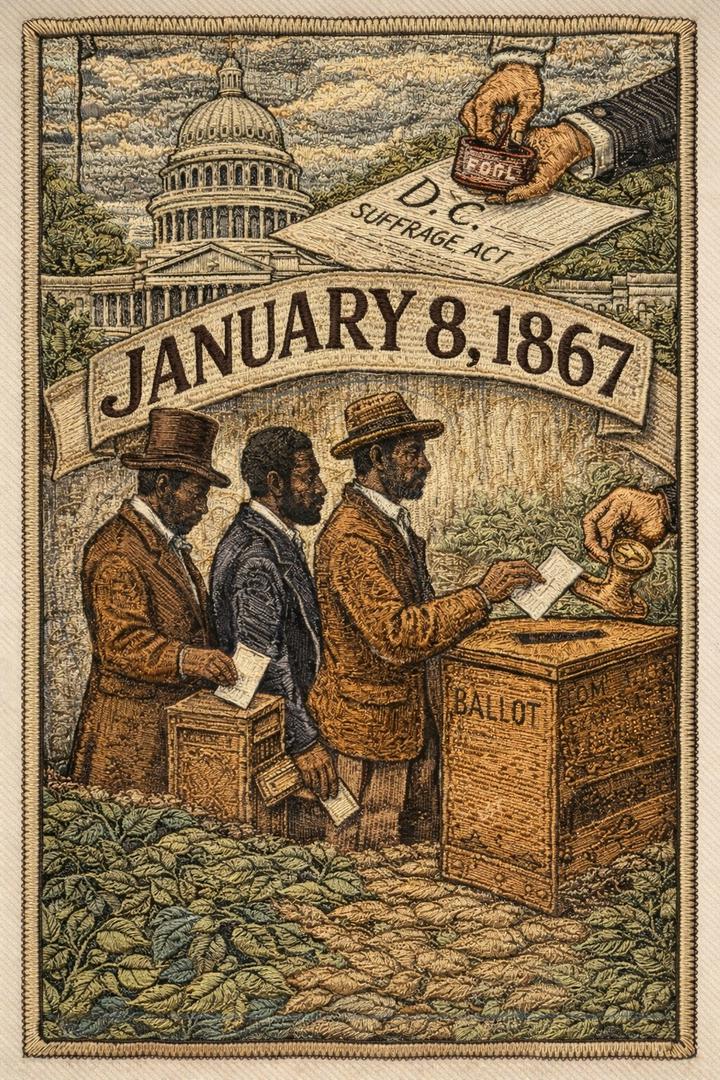
January 8, 1867 marks a turning point in American history that is rarely given the attention it deserves. On this day, Congress passed the District of Columbia Suffrage Act, granting Black men in Washington, D.C. the legal right to vote in municipal elections and public referenda. This happened three years before the 15th Amendment, at a time when most of the nation still viewed Black political participation as a danger rather than a right. This was not a promise for the future or a symbolic gesture. It was an immediate, enforceable change written directly into law. The decision did not come quietly or without resistance. President Andrew Johnson vetoed the act, arguing that extending voting rights to Black men was premature and would destabilize the country. Congress rejected that argument and overrode his veto the same day. That override mattered. It made clear that Reconstruction was not only about ending slavery on paper but about redistributing political power in real time. Washington, D.C. became a proving ground, showing that Black civic participation could exist and function despite fierce opposition. The importance of January 8, 1867 is often overlooked because it does not fit neatly into the simplified version of history many are taught. Voting rights did not suddenly appear with the 15th Amendment. They were demanded, tested, expanded, restricted, and attacked repeatedly. This moment captures Black men exercising political agency while the nation was still debating whether they deserved it. It reminds us that progress has never required national comfort or unanimous approval. Rights have always moved forward through pressure, confrontation, and refusal to wait. January 8 stands as proof that access was forced open long before the country was ready to admit it. #January8 #OnThisDay #BlackHistory #ReconstructionEra #VotingRights #DistrictOfColumbia #AmericanHistory #HiddenHistory #CivilRights

LataraSpeaksTruth

December 21, 1956 is often remembered as the end of the Montgomery Bus Boycott, but more precisely, it marks the first day Montgomery’s city buses operated as integrated in daily life. The legal battle had already been won, yet this morning mattered because it was when the ruling became visible, physical, and unavoidable. After more than a year of walking, carpooling, and enduring harassment, Black residents of Montgomery boarded buses alongside white passengers under a new reality. The Supreme Court decision banning bus segregation had finally reached Alabama, and the city was required to comply. December 21 was the morning the mandate moved from paper to pavement. That day, community leaders and ordinary citizens rode together. Among them was Martin Luther King Jr, who boarded a bus quietly, without fanfare. There were no speeches, no celebrations, and no cameras chasing spectacle. What made the moment powerful was its calm. People simply sat where the law now said they could sit. The boycott itself officially ended when the legal order took effect, which is why some summaries list earlier dates. But December 21 endures in public memory because it represents the first lived experience of change. It was not just a court victory. It was a morning commute transformed by discipline, unity, and resolve. For 381 days, Montgomery’s Black community refused to accept injustice as routine. On December 21, 1956, routine finally changed. History did not announce itself loudly that morning. It showed up on time, paid its fare, and took a seat. #MontgomeryBusBoycott #CivilRightsHistory #December21 #AmericanHistory #BlackHistory

LataraSpeaksTruth

On March 24, 1862, abolitionist speaker Wendell Phillips was shouted down by an angry crowd in Cincinnati, Ohio, while trying to deliver an antislavery lecture. He was not some obscure man speaking on a street corner. Phillips was one of the best-known anti-slavery voices in the country, a Boston reformer, Harvard-educated lawyer, and commanding public speaker so admired that he became known as abolitionism’s “golden trumpet.”  That is what makes the reaction so revealing. The Civil War was already underway, slavery was at the heart of the nation’s crisis, and yet there were still Americans who did not want to hear a direct moral argument against it. Contemporary reporting from Cincinnati said that after Phillips identified himself as an abolitionist, people in the galleries hissed, yelled, and threw eggs and stones at him. History’s summary says he was pelted with rocks and eggs, and that friends rushed him away when the scene broke into a small riot.  This moment matters because it strips away the comforting fantasy that everybody would have stood on the right side of history. People today love to imagine they would have been brave, principled, and clear-eyed in that era. But in real time, even speaking publicly against slavery could bring fury, threats, and mob violence. Telling the truth was dangerous. Saying human beings should not be owned was enough to make some people erupt.  Wendell Phillips spent years using his voice to challenge slavery and, after the war, to press for equal rights more broadly. So this was not just a man getting booed. It was a public collision over whether the country was willing to face its own cruelty. March 24, 1862, reminds us that resistance to justice did not always wear a uniform. Sometimes it sat in the audience, waited for the truth, and then exploded when it heard it.  #OnThisDay #WendellPhillips #USHistory #SlaveryHistory #BlackHistory Sources: History; Encyclopaedia Britannica

LataraSpeaksTruth

Septima Poinsette Clark (1898–1987) was a quiet force who shaped the soul of the Civil Rights Movement through something radical: teaching. Born in Charleston, South Carolina, she believed literacy and education were tools for liberation. Her greatest legacy came through the creation of Citizenship Schools, grassroots classrooms that taught African Americans to read, write, and understand their rights so they could register to vote and become leaders. Fired from her teaching job in 1956 for being a member of the NAACP, Clark didn’t back down. Instead, she expanded her work with the Highlander Folk School and the Southern Christian Leadership Conference, training thousands of teachers and activists throughout the South. Many of her students went on to become civil rights leaders in their own right. Dr. Martin Luther King Jr. called her work “the key to the movement.” Yet because she was a Black woman in a male-dominated movement, Clark’s contributions were often overlooked. Still, she remained committed to justice through knowledge, saying, “I believe unconditionally in the ability of people to respond when they are told the truth.” In 1979, she received the Living Legacy Award from President Jimmy Carter. But her true legacy lives on in the power of informed people standing up for their rights, not just in courtrooms or marches, but in classrooms, living rooms, and voting booths. Gone but not forgotten. Her life reminds us: freedom begins with learning. #GoneButNotForgotten #SeptimaClark #BlackHistory #CivilRights #EducationAsResistance #CitizenshipSchools #LegacyOfLiteracy

LataraSpeaksTruth

March 21, 1856 - Henry Ossian Flipper was born in Thomasville, Georgia, into slavery. His life began in a nation that had already decided how far Black people were supposed to go, and how firmly they were supposed to stay in their place. Flipper had other plans. He came of age during Reconstruction and, in 1873, was appointed to the U.S. Military Academy at West Point, one of the most elite institutions in the country. Getting in was one battle. Surviving it was another. He faced harassment, isolation, and open hostility, yet refused to be broken by any of it. In 1877, Henry Ossian Flipper became the first Black graduate of West Point and the first Black commissioned officer in the regular U.S. Army. That was no small ceremonial first. It was a direct blow against a system built to exclude Black Americans from military leadership, prestige, and power. His success proved what had always been true: the barrier was never ability, it was racism. After graduation, Flipper served with the 10th Cavalry, one of the famed Buffalo Soldier regiments. His career reflected discipline, endurance, and service, even as injustice continued to follow him. Still, history remembers what matters most: Henry Ossian Flipper crossed a line this country never intended for a Black man to cross… and he did it in uniform. His name deserves to be spoken with respect, not tucked away like a footnote. Sources: National Archives, U.S. Army #OnThisDay #BlackHistory #HenryOssianFlipper #WestPoint #BuffaloSoldiers #MilitaryHistory #BlackExcellence #HiddenHistory #AmericanHistory #BlackPioneers

LataraSpeaksTruth

On January 7, 1891, Zora Neale Hurston was born, and from day one she refused to explain herself to anyone. Writer, folklorist, anthropologist, cultural archivist, Hurston did more than tell stories. She preserved Black Southern life at a time when America was determined to clean it up, water it down, or erase it completely. Born in Alabama and raised in Eatonville, one of the first all-Black incorporated towns in the United States, Hurston grew up surrounded by self-rule, language, humor, and folklore. That world shaped everything she wrote. While others debated how Black life should be portrayed, Hurston wrote it as it was. Musical. Messy. Funny. Painful. Proud. During the Harlem Renaissance, she stood apart because she refused to center her work around white comfort. She traveled throughout the South and the Caribbean collecting folktales, songs, and oral histories, treating everyday people as experts of their own lives. She captured speech, rituals, beliefs, and humor that scholars had dismissed for generations and proved they mattered. Her most famous novel, Their Eyes Were Watching God, centered the inner life of a Black woman when few believed that story deserved space. When it was published, it was criticized for being too Southern and not political enough. Time corrected that mistake. Today it stands as a cornerstone of American literature and a reminder that joy, love, and voice are political too. Hurston died in poverty in 1960 and was buried in an unmarked grave. Years later, her work was rediscovered and restored to its rightful place. Her legacy proves that truth does not always shout. Sometimes it survives quietly, waiting for the world to finally listen. #ZoraNealeHurston #January7 #BlackHistory #HarlemRenaissance #LiteraryHistory #AmericanWriters #HiddenHistory #WomensHistory #BlackLiterature #CulturalPreservation

LataraSpeaksTruth

On December 4, 1950, Ensign Jesse LeRoy Brown, the first Black man to complete U.S. Navy flight training and serve as a naval aviator, was shot down while flying close air support during the Korean War near the Chosin Reservoir. He crash landed in the snow, badly injured and trapped in the wreckage, while his wingman, Thomas J. Hudner Jr., made a desperate rescue attempt, even crash landing nearby to try to reach him. Brown did not survive, and his remains were never recovered, but his legacy did not end on that frozen mountainside. He became a permanent symbol of excellence earned through barriers, and a reminder that service, skill, and courage have always been bigger than the limits people tried to place on them. #ThisDayInHistory #KoreanWar #USNavy #NavalAviation #MilitaryHistory #JesseLBrown #BlackHistory #ChosinReservoir

LataraSpeaksTruth

Guion S. Bluford Jr. The First African American To Reach Space

Guion Stewart Bluford Jr. was born on November 22, 1942, in Philadelphia. His birthday sits inside a chapter of history that America rarely slows down long enough to honor. He grew up in a home that valued discipline, education, and excellence. That foundation shaped everything that came next. He served as an officer in the United States Air Force and became a skilled fighter pilot with more than one hundred forty missions during the Vietnam War. He later earned multiple advanced degrees in aerospace engineering and moved through a field where many rooms did not expect to see him. He stayed anyway. He studied harder. He pushed forward. On August 30, 1983, the Space Shuttle Challenger lifted off from Cape Canaveral. Bluford stepped into a role that had never been open to anyone before him. Millions watched a Black man take a seat that represented possibility for families who had been told to keep their dreams “realistic.” His presence in that shuttle changed the imagination of a generation. Bluford continued flying missions for NASA and contributed to research on fluid dynamics, microgravity, and space systems. His work helped expand what we understand about living and operating beyond Earth. His career became a long record of discipline, focus, and quiet excellence. Today his legacy shows up in STEM programs, scholarships, and young students who see him as proof that their gifts belong in every room. His birthday is a reminder that representation in science is not symbolic. It is real. It is necessary. And it still matters. #GuionBluford #BlackHistory #AmericanHistory #STEMHistory #SpaceAchievement #Trailblazer #NewsBreakHistory

Guion S. Bluford Jr.
The First African American To Reach Space
LataraSpeaksTruth

Preserving Her Legacy: The Birth of the National Archives for Black Women’s History

Mary McLeod Bethune never stopped building. Long after she founded the National Council of Negro Women in 1935 she realized something deeper was missing. The voices of Black women who shaped America were scattered in pieces across the country. Letters diaries speeches photos and records of a people who had built schools led marches raised communities and lifted generations were at risk of being forgotten. So she took action again. Out of that vision came the National Archives for Black Women’s History in Washington D.C. The archive was created to collect preserve and share the stories of African American women whose impact was too often ignored by mainstream institutions. It became the first national archive devoted entirely to documenting the achievements struggles and leadership of Black women throughout American history. Bethune’s own papers and those of the National Council of Negro Women became the foundation. From there the collection grew to include photographs letters oral histories and rare documents from educators activists and community leaders who changed the world in quiet and powerful ways. The National Archives for Black Women’s History stands today as a home for memory. Every file and photograph reminds us that our stories matter and that progress has roots. Bethune believed that education and history go hand in hand. She wanted future generations to see the strength of Black women not just in the pages of history books but in the evidence of their own hands and voices. Her vision was clear. What we do must be remembered. And through this archive her legacy keeps every name every story and every victory alive. A woman who built schools also built a home for our memories. #BlackHistory #MaryMcLeodBethune #WomensHistory #NABWH #CommunityVoices #LegacyLivesHere

Preserving Her Legacy: The Birth of the National Archives for Black Women’s HistoryPreserving Her Legacy: The Birth of the National Archives for Black Women’s History
LataraSpeaksTruth

On this day in 1967, the world lost one of the greatest voices to ever touch soul music. Otis Redding was on his way to a performance in Madison, Wisconsin when his plane crashed into Lake Monona. He was only 26, right in the middle of building a legendary career that was already changing the sound of American music. What makes this loss even more powerful is the timing. Just days before the crash, Otis had stepped into the studio and recorded “(Sittin’ On) The Dock of the Bay.” No one knew it would become his final masterpiece. After his death, the song rose to number one and became the first posthumous chart-topping single in U.S. history. A quiet, reflective track that felt like a man looking out at the world became a symbol of everything he never got the chance to finish. Otis was already a force… from the Monterey Pop Festival to stages across the country. His voice carried grit, emotion, and truth. When he performed, he didn’t just sing… he offered a piece of himself. His impact stretched far beyond the charts, shaping the sound of soul music for generations. The news of his death hit hard. Fans mourned. Fellow musicians fell silent. And anyone who had heard him sing knew the world had lost something rare. Even now, decades later, his influence hasn’t faded. His music lives in samples, covers, tributes, and the way artists chase honesty in their sound. Today we honor Otis Redding, a talent gone far too soon, but never forgotten. His voice still echoes through time, reminding us how powerful one song… one moment… one life can be. #BlackHistory #LataraSpeaksTruth #OnThisDay #MusicHistory #OtisRedding #SoulMusic #RememberingLegends #HistoryMatters #TodayInHistory #CommunityPost

Tag: BlackHistory | LocalAll