Tag Page americanhistory

#americanhistory
LataraSpeaksTruth

On January 26, 1892, Bessie Coleman was born into a country that told her exactly what she could not be. She listened long enough to understand the rules…and then broke every one of them. When no flight school in the United States would admit a Black woman, Bessie didn’t argue. She learned French, left the country, and trained in France. In 1921, she earned her pilot’s license, becoming the first Black woman and first Native American woman to do so. Not because the system opened a door…but because she refused to wait for one. Bessie didn’t fly for novelty. She flew with purpose. She believed aviation should belong to everyone, and she dreamed of opening a flight school so others wouldn’t have to leave the country just to learn. She refused to perform at airshows that enforced segregation. If audiences were divided, she walked. Progress without dignity wasn’t progress to her. As a barnstormer, she stunned crowds with daring aerial maneuvers, turning the sky into a stage for possibility. Each flight was a quiet rebellion against limitation, proof that skill and courage don’t ask permission. Her life ended too soon. Bessie Coleman died in a plane crash in 1926 at just 34 years old. But her impact never grounded. Every pilot who followed, every barrier lifted higher, carries a trace of her flight path. Some people change history by staying. Others change it by leaving, learning, and coming back stronger. Bessie Coleman did all three. Born January 26. Legacy everlasting. #BessieColeman #January26 #OnThisDay #WomenInHistory #AviationHistory #Trailblazer #AmericanHistory #HistoryMatters #Legacy #BlackExcellence
LataraSpeaksTruth

January 8, 1815. The Battle of New Orleans. The War of 1812 was technically over. The Treaty of Ghent had been signed, but word had not crossed the Atlantic yet. Slow communication changed everything. British forces attacked New Orleans anyway and were met by an American force led by Andrew Jackson. His army was not a traditional one. It included U.S. regulars, state militias, Native allies, free Black soldiers, local Creoles, and even pirates under Jean Lafitte. The result was one of the most lopsided victories in U.S. military history. Over 2,000 British casualties compared to roughly 70 American losses. The battle did not change the treaty, but it reshaped American identity. It boosted national confidence, made Jackson a national hero, and proved that the United States could stand up to the world’s most powerful empire. Free Black soldiers played a critical role in defending the city. Their bravery was undeniable. Their recognition afterward was not. This victory was not simple, clean, or fair. It was complex, coalition-driven, and built by people history often sidelines. #January8 #BattleOfNewOrleans #WarOf1812 #AmericanHistory #USHistory #MilitaryHistory #BlackHistory #HiddenHistory

LataraSpeaksTruth

January 24, 1956 marked one of the most disturbing chapters in American history, not because justice was served, but because the truth was openly confessed without consequence. On this date, Look magazine published the paid confessions of the men who kidnapped, tortured, and murdered 14 year old Emmett Till after they had already been acquitted by an all white jury in Mississippi. Protected by double jeopardy, they spoke freely, detailing violence the courtroom had refused to name. The confessions confirmed what many already understood…the verdict was never about evidence, innocence, or law. It was about power. The legal system had functioned exactly as it was designed to, shielding brutality while pretending to uphold justice. Emmett Till’s killing exposed the machinery of Jim Crow justice in its rawest form, where cruelty could operate in daylight and accountability simply did not exist. His death was not treated as a tragedy by the courts, but as an inconvenience quickly brushed aside. Yet the story does not end with the killers. It continues with Mamie Till Mobley, a mother who refused silence, who chose an open casket so the world would see what hatred had done to her child. Those images traveled far beyond Mississippi, cutting through denial and forcing a nation to confront itself. Emmett Till did not set out to change history, but his death became a turning point, galvanizing resistance and awakening consciences that could no longer pretend ignorance. This was not a moment of closure, but of exposure. A reminder that sometimes the most painful truths arrive not through justice, but through the courage to tell what the system tried to bury. #EmmettTill #January24 #AmericanHistory #HistoricalRecord #JimCrowEra #CivilRightsHistory #TruthMatters #NeverForgotten #HistoryYouNeedToKnow

LataraSpeaksTruth

Edwin C. Berry was born in 1854 in Oberlin, Ohio and would grow into one of the most successful Black hoteliers of his era. His story is one of discipline, skill, and a refusal to be boxed in by the limits placed on Black ambition during the late nineteenth and early twentieth century. Berry trained as a barber first, a field where Black men were often able to build steady clientele and earn financial stability. That experience taught him how to read people, manage money, and understand the rhythm of business. Those skills opened the door to something bigger. He moved to Athens, Ohio where he took a bold step. He purchased and transformed a modest boarding house into what became the Hotel Berry, a respected establishment that drew travelers from across the region. At a time when segregation blocked Black travelers from many accommodations, Berry created a place known for its order, comfort, and professionalism. His hotel earned praise from both Black and white patrons which was rare for the period. People noted the elegance of the space and the discipline with which Berry ran it. His success was not just about hospitality. It showed what strong Black leadership looked like during a time when opportunities were limited and racial barriers were constant. Berry built wealth, provided jobs, and raised the standard for what Black owned businesses could achieve. His life stands as a reminder that history is filled with stories of Black excellence that shaped communities long before these contributions were fully acknowledged. Berry’s legacy still inspires people who understand how hard he had to work to build what he built. #EdwinCBerry #BlackHistory #AmericanHistory #AthensOhio #HotelBerry #LataraSpeaksTruth

LataraSpeaksTruth

January 13, 1777 did not arrive with celebration or ceremony, but it carried one of the clearest moral confrontations of the Revolutionary era. On this day, Prince Hall and seven other Black men formally petitioned the Massachusetts legislature for freedom on behalf of those held in bondage. Their argument was not emotional pleading. It was political, logical, and devastatingly precise. If the colonies were fighting a war over natural rights and liberty, then slavery stood in direct contradiction to the very ideals being proclaimed. The petitioners pointed to the hypocrisy plainly. They reminded lawmakers that Black men were being taxed, governed, and even conscripted, while denied the freedom those sacrifices were supposedly defending. This was not a request for gradual reform or future consideration. It was a direct challenge to the legitimacy of slavery itself. The men asserted that freedom was not a gift to be granted at convenience but a right already owed. The legislature did not immediately abolish slavery in response. Power rarely moves that fast. But the petition mattered because it created a permanent written record of resistance from within the system. It forced lawmakers to confront the contradiction in ink, preserved in official archives. It also helped lay the groundwork for later legal challenges that would ultimately dismantle slavery in Massachusetts by the early 1780s. Prince Hall would go on to become one of the most influential Black leaders of the eighteenth century, founding Black institutions, advocating education, and organizing community defense. But on January 13, 1777, his legacy was already clear. He understood that freedom is not begged for quietly. It is demanded clearly, publicly, and without apology. History remembers battles and speeches. It should also remember petitions like this one. Because sometimes the most dangerous thing to a system built on contradiction is a document that tells the truth. #OnThisDay #January13 #America

LataraSpeaksTruth

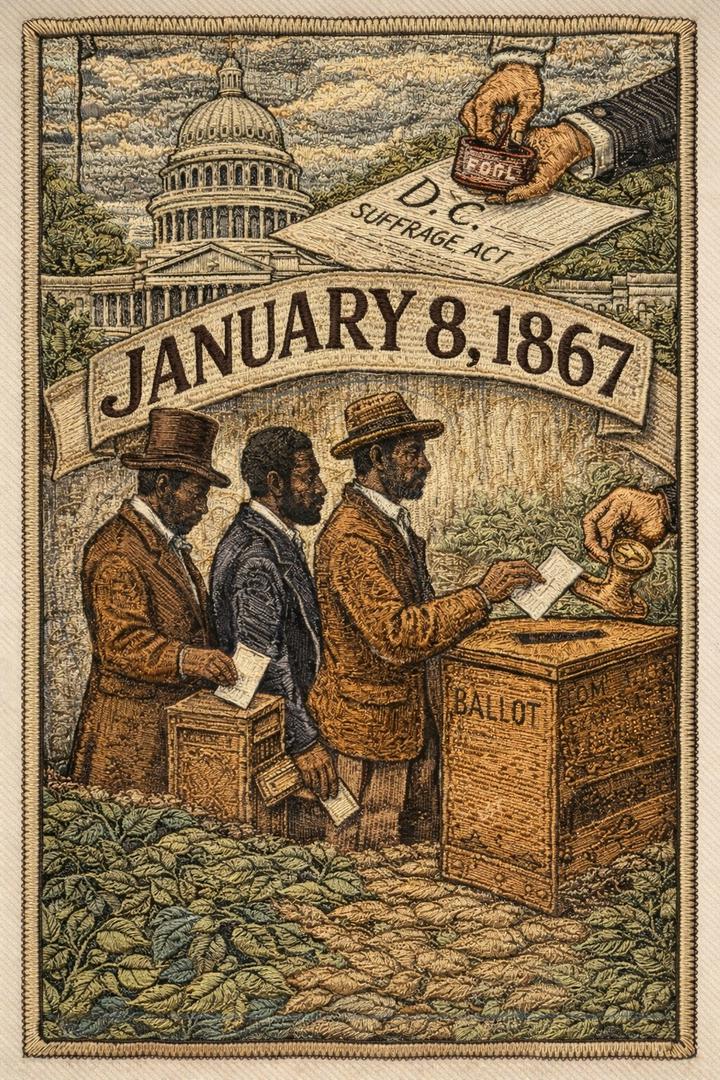
January 8, 1867 marks a turning point in American history that is rarely given the attention it deserves. On this day, Congress passed the District of Columbia Suffrage Act, granting Black men in Washington, D.C. the legal right to vote in municipal elections and public referenda. This happened three years before the 15th Amendment, at a time when most of the nation still viewed Black political participation as a danger rather than a right. This was not a promise for the future or a symbolic gesture. It was an immediate, enforceable change written directly into law. The decision did not come quietly or without resistance. President Andrew Johnson vetoed the act, arguing that extending voting rights to Black men was premature and would destabilize the country. Congress rejected that argument and overrode his veto the same day. That override mattered. It made clear that Reconstruction was not only about ending slavery on paper but about redistributing political power in real time. Washington, D.C. became a proving ground, showing that Black civic participation could exist and function despite fierce opposition. The importance of January 8, 1867 is often overlooked because it does not fit neatly into the simplified version of history many are taught. Voting rights did not suddenly appear with the 15th Amendment. They were demanded, tested, expanded, restricted, and attacked repeatedly. This moment captures Black men exercising political agency while the nation was still debating whether they deserved it. It reminds us that progress has never required national comfort or unanimous approval. Rights have always moved forward through pressure, confrontation, and refusal to wait. January 8 stands as proof that access was forced open long before the country was ready to admit it. #January8 #OnThisDay #BlackHistory #ReconstructionEra #VotingRights #DistrictOfColumbia #AmericanHistory #HiddenHistory #CivilRights

LataraSpeaksTruth

The tragedy at Ebenezer Creek remains one of the most devastating and overlooked moments of the Civil War. As Union troops advanced toward Savannah during Sherman’s March to the Sea, hundreds of freedom seekers followed behind them, believing the army represented safety and a chance at a future beyond bondage. They walked for days beside the soldiers, carrying children, bundles, and the weight of generations. When they reached the cold waters of Ebenezer Creek, Union General Jefferson C. Davis ordered his men to cross first on a pontoon bridge. Once the troops were safely over, the bridge was pulled up without warning, leaving the refugees stranded as Confederate forces closed in. Panic spread as families realized they were trapped with nowhere to run. People leapt into the water, clinging to anything that might float, pieces of wood, clothing, each other. Many drowned trying to reach the other side. Others were captured. A moment that should have been a step toward freedom turned into a night of terror and loss. The massacre at Ebenezer Creek exposed a harsh truth of that era… even in a war fought over slavery, the safety of Black refugees was treated as negotiable. Their trust was betrayed, their lives dismissed, and their suffering pushed to the margins of history. And before anyone shows up with the tired “move on, this is old news, get over the past” routine, let me help you out… how about you move on? I’m from Georgia and in all my years in this state I never once heard about this. I’m learning it right alongside everyone else. This is exactly why these stories matter. History doesn’t disappear just because it makes people uncomfortable. We deserve to know what happened on the soil we stand on. #LataraSpeaksTruth #BlackHistory #AmericanHistory #HiddenHistory #Under2000Characters

LataraSpeaksTruth

Remembering the Gettysburg Address

On November 19, 1863, President Abraham Lincoln stood on the battlefield at Gettysburg and delivered a message that reshaped how the nation understood the Civil War. The ceremony was meant to honor the thousands of soldiers who died there, but Lincoln used the moment to remind the country what the fight was really about. In just a few sentences, he connected the war to the country’s earliest promise that all people are created equal, and he challenged Americans to keep working toward a future where that promise actually means something. The speech was short, but the impact has lasted generations. Lincoln said the world would not remember what was said that day, but the opposite became true. The Gettysburg Address became a reminder that freedom, sacrifice, and democracy require constant work. Even now, the words push us to think about what kind of nation we want to be and whether we’re living up to the ideals we claim to stand on. #HistoryMatters #GettysburgAddress #OnThisDay #AmericanHistory #LataraSpeaksTruth

Remembering the Gettysburg Address
LataraSpeaksTruth

Born January 23, 1904, Benjamin A. Quarles reshaped how American history is understood by insisting on something radical for his time…evidence. At a moment when Black participation in the nation’s founding wars was minimized, distorted, or erased entirely, Quarles documented it with academic rigor that could not be dismissed. His work made clear that Black people were not passive observers of American history but active participants at every critical turning point. Quarles is best known for his groundbreaking scholarship on Black involvement in the American Revolution, the Civil War, and abolitionist movements. In The Negro in the American Revolution, he demonstrated that enslaved and free Black people fought on both sides, negotiated for freedom, served as soldiers, spies, laborers, and strategists, and understood the stakes of liberty long before it was promised to them. This was not symbolic participation…it was material, strategic, and consequential. His later work, including The Negro in the Civil War, further dismantled the false narrative that Black Americans were merely recipients of freedom rather than agents who helped force its arrival. Quarles grounded his arguments in military records, correspondence, pensions, and primary documents, placing Black lives firmly inside the official archive rather than on its margins. What made Quarles especially significant was not only what he proved, but how he proved it. He operated inside the academy with discipline and restraint, producing scholarship that met the highest standards while challenging the foundations of historical exclusion. His work became required reading not because it was provocative, but because it was undeniable. Benjamin A. Quarles did not write history to inspire sentiment. He wrote it to correct the record. And once corrected, that record could no longer pretend that freedom arrived without Black hands helping to build it. #BenjaminAQuarles #OnThisDay #AmericanHistory #AbolitionHistory