Category Page news

Curiosity Corner

The Science Behind Alien Abductions About three percent of Americans believe they were abducted by aliens, and scientists study why these events feel real. One major cause is sleep paralysis, a state where the brain wakes up but the body remains frozen. People can see figures in the room, feel pressure on their chest, hear voices, or sense floating. Around eight percent of people experience this at least once. The brain tries to explain these intense sensations and often uses familiar images, which for many are aliens that match well known cultural patterns and long standing ideas shared across society. Memory also plays a major role. Human memory is flexible and can create vivid false memories under suggestion or stress. Experiments show that nearly one third of people can form detailed memories of events that never happened. Abduction stories often expand over time as the brain adds new layers that feel completely real. The brain itself can generate powerful sensations. The temporal lobe controls imagination, fear, and the feeling that someone is nearby. Disturbances from migraines, seizures, or certain magnetic fields can trigger the sense of a presence. In laboratory tests more than half of participants reported feeling a figure when this area was stimulated. Many people describe the same type of alien because culture gives everyone a shared template. Movies and television popularized the small gray figure with large eyes. When someone experiences sleep paralysis or a neurological event, the mind often fills in the unknown with this familiar image that has been reinforced repeatedly over decades and now feels almost universal. Together these scientific factors explain why alien abduction accounts feel real, why many witnesses report similar details, and why a small but notable share of Americans believe they were taken. #Aliens #America #Science #USA #ScienceNews #News

SuuzieQ with a view

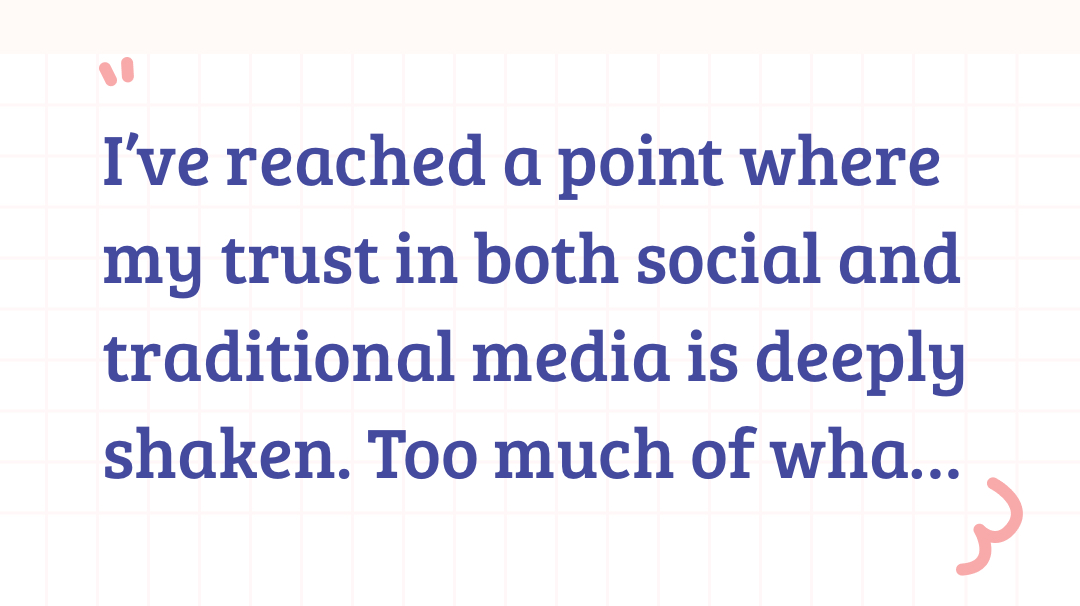
I’ve reached a point where my trust in both social and traditional media is deeply shaken. Too much of what passes for “news” today is not careful reporting, but opinion-driven narrative, framed to provoke emotion rather than convey truth. Facts are often secondary to sensationalism, and complexity is sacrificed for clicks, outrage, and speed. When stories are presented as moral verdicts instead of verified information, the public is not being informed — it’s being steered. What concerns me most is how this environment fractures our shared reality. Social media amplifies the loudest voices, not the most accurate ones, and news outlets too often follow that noise instead of challenging it. This creates division where nuance should exist and hostility where dialogue is needed. A nation cannot function when its citizens are constantly pushed into opposing camps based on incomplete or slanted information. History shows that strong countries are rarely destroyed from the outside; they weaken from within. When media and platforms reward outrage, distrust, and tribalism, they do our adversaries’ work for them — without a single shot fired. If we value our democracy and our future, we must demand higher standards: fact over narrative, evidence over emotion, and truth over influence. A free press is essential, but credibility is earned, not assumed.

Nikki Sanders

A cheap clock clicks. A single bulb throws a jaundiced light over a cramped room: mismatched furniture, stacks of unpaid bills, a small kitchen with jars of utensils. On the fridge, a faded black-and-white PHOTO of a woman in her thirties—MARIE—pinned with a crooked magnet. STEVE MARR, late seventies, bandages still wrapped around his head, sits on the edge of a sagging armchair. His hands tremble. He stares at a shoebox on the coffee table as if the box holds the answer. He peels the first strip of gauze. The adhesive protests. He grunts. The strip comes away with a small rip. STEVE (rough, surprised) Jesus... He peels the rest in quick, angry motions. Gauze falls like confetti. The light hits his face. He flinches and then studies himself. He crosses to an old mirror propped against the wall. The face that looks back is younger than it should be, cheekbones rearranged, a softened jaw. And impossibly, the tilt of the eyes, the little scar near the lip—it's Marie. STEVE No. No, no, no. He slaps the glass, not hard, more to steady himself. The echo gives him courage. He leans close, fingers tracing a contour that used to feel like his own. STEVE (under his breath) You wanted fresh, Steve. Not—this. He moves to the fridge, fingers hover over Marie's photo. He takes it down, holds it beside his face. The resemblance is undeniable. STEVE (laughing, then bitter) You look like her. You look like her because someone wants you to look like her. He opens the shoebox. Inside: discharge papers, a faded matchbook for a motel, a single glove, a stapled invoice from "PEREGRINE CLINIC — FACIAL SUTURE/RECONSTRUCTION." He snaps the invoice open. His eyes skim the print, slowing. STEVE (reading aloud) "Procedure complete. Recommended follow-up in two weeks. Consent received." He pins the paper down with a shaking hand. He flips the invoice—someone scrawled a name: "M. Harris." Not his. STEVE Who signs for me? Who— He slams the shoebox shut. He paces, slow, like an old