Tag Page hiddenhistory

#hiddenhistory
LataraSpeaksTruth

On January 7, 1891, Zora Neale Hurston was born, and from day one she refused to explain herself to anyone. Writer, folklorist, anthropologist, cultural archivist, Hurston did more than tell stories. She preserved Black Southern life at a time when America was determined to clean it up, water it down, or erase it completely. Born in Alabama and raised in Eatonville, one of the first all-Black incorporated towns in the United States, Hurston grew up surrounded by self-rule, language, humor, and folklore. That world shaped everything she wrote. While others debated how Black life should be portrayed, Hurston wrote it as it was. Musical. Messy. Funny. Painful. Proud. During the Harlem Renaissance, she stood apart because she refused to center her work around white comfort. She traveled throughout the South and the Caribbean collecting folktales, songs, and oral histories, treating everyday people as experts of their own lives. She captured speech, rituals, beliefs, and humor that scholars had dismissed for generations and proved they mattered. Her most famous novel, Their Eyes Were Watching God, centered the inner life of a Black woman when few believed that story deserved space. When it was published, it was criticized for being too Southern and not political enough. Time corrected that mistake. Today it stands as a cornerstone of American literature and a reminder that joy, love, and voice are political too. Hurston died in poverty in 1960 and was buried in an unmarked grave. Years later, her work was rediscovered and restored to its rightful place. Her legacy proves that truth does not always shout. Sometimes it survives quietly, waiting for the world to finally listen. #ZoraNealeHurston #January7 #BlackHistory #HarlemRenaissance #LiteraryHistory #AmericanWriters #HiddenHistory #WomensHistory #BlackLiterature #CulturalPreservation

LataraSpeaksTruth

January 8, 1815. The Battle of New Orleans. The War of 1812 was technically over. The Treaty of Ghent had been signed, but word had not crossed the Atlantic yet. Slow communication changed everything. British forces attacked New Orleans anyway and were met by an American force led by Andrew Jackson. His army was not a traditional one. It included U.S. regulars, state militias, Native allies, free Black soldiers, local Creoles, and even pirates under Jean Lafitte. The result was one of the most lopsided victories in U.S. military history. Over 2,000 British casualties compared to roughly 70 American losses. The battle did not change the treaty, but it reshaped American identity. It boosted national confidence, made Jackson a national hero, and proved that the United States could stand up to the world’s most powerful empire. Free Black soldiers played a critical role in defending the city. Their bravery was undeniable. Their recognition afterward was not. This victory was not simple, clean, or fair. It was complex, coalition-driven, and built by people history often sidelines. #January8 #BattleOfNewOrleans #WarOf1812 #AmericanHistory #USHistory #MilitaryHistory #BlackHistory #HiddenHistory

LataraSpeaksTruth

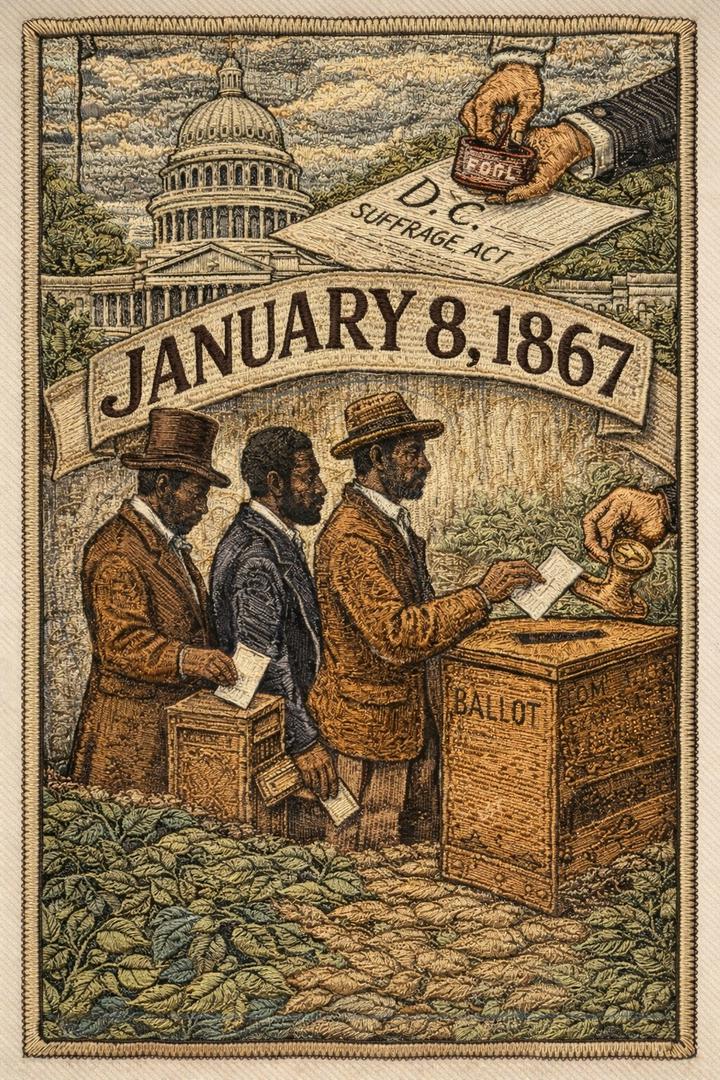
January 8, 1867 marks a turning point in American history that is rarely given the attention it deserves. On this day, Congress passed the District of Columbia Suffrage Act, granting Black men in Washington, D.C. the legal right to vote in municipal elections and public referenda. This happened three years before the 15th Amendment, at a time when most of the nation still viewed Black political participation as a danger rather than a right. This was not a promise for the future or a symbolic gesture. It was an immediate, enforceable change written directly into law. The decision did not come quietly or without resistance. President Andrew Johnson vetoed the act, arguing that extending voting rights to Black men was premature and would destabilize the country. Congress rejected that argument and overrode his veto the same day. That override mattered. It made clear that Reconstruction was not only about ending slavery on paper but about redistributing political power in real time. Washington, D.C. became a proving ground, showing that Black civic participation could exist and function despite fierce opposition. The importance of January 8, 1867 is often overlooked because it does not fit neatly into the simplified version of history many are taught. Voting rights did not suddenly appear with the 15th Amendment. They were demanded, tested, expanded, restricted, and attacked repeatedly. This moment captures Black men exercising political agency while the nation was still debating whether they deserved it. It reminds us that progress has never required national comfort or unanimous approval. Rights have always moved forward through pressure, confrontation, and refusal to wait. January 8 stands as proof that access was forced open long before the country was ready to admit it. #January8 #OnThisDay #BlackHistory #ReconstructionEra #VotingRights #DistrictOfColumbia #AmericanHistory #HiddenHistory #CivilRights

LataraSpeaksTruth

The tragedy at Ebenezer Creek remains one of the most devastating and overlooked moments of the Civil War. As Union troops advanced toward Savannah during Sherman’s March to the Sea, hundreds of freedom seekers followed behind them, believing the army represented safety and a chance at a future beyond bondage. They walked for days beside the soldiers, carrying children, bundles, and the weight of generations. When they reached the cold waters of Ebenezer Creek, Union General Jefferson C. Davis ordered his men to cross first on a pontoon bridge. Once the troops were safely over, the bridge was pulled up without warning, leaving the refugees stranded as Confederate forces closed in. Panic spread as families realized they were trapped with nowhere to run. People leapt into the water, clinging to anything that might float, pieces of wood, clothing, each other. Many drowned trying to reach the other side. Others were captured. A moment that should have been a step toward freedom turned into a night of terror and loss. The massacre at Ebenezer Creek exposed a harsh truth of that era… even in a war fought over slavery, the safety of Black refugees was treated as negotiable. Their trust was betrayed, their lives dismissed, and their suffering pushed to the margins of history. And before anyone shows up with the tired “move on, this is old news, get over the past” routine, let me help you out… how about you move on? I’m from Georgia and in all my years in this state I never once heard about this. I’m learning it right alongside everyone else. This is exactly why these stories matter. History doesn’t disappear just because it makes people uncomfortable. We deserve to know what happened on the soil we stand on. #LataraSpeaksTruth #BlackHistory #AmericanHistory #HiddenHistory #Under2000Characters

Hatter Gone Mad

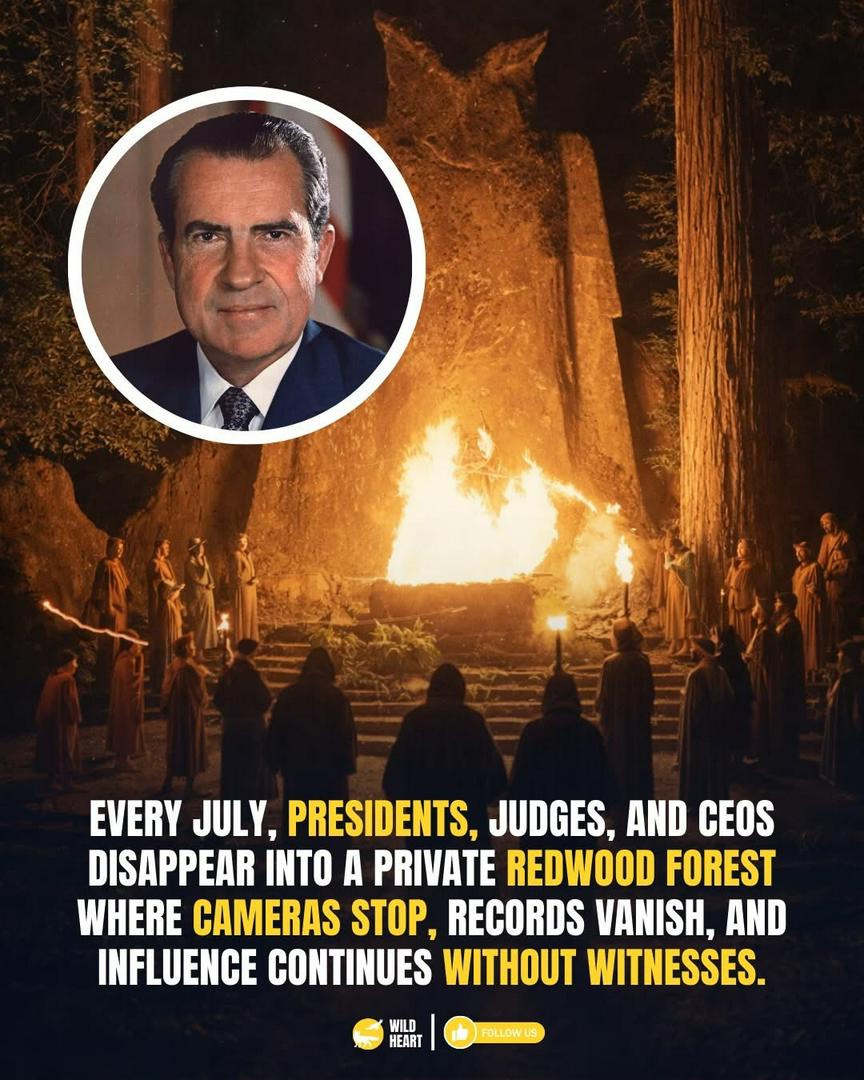
Every July, some of the most powerful men on Earth quietly vanish into a redwood forest in Northern California, and almost no one is meant to talk about what happens next. The place is Bohemian Grove, a private 2,700-acre retreat owned by the Bohemian Club. Former U.S. presidents, intelligence leaders, military officials, judges, and CEOs attend. Phones are restricted. Press is barred. The motto hanging over the event reads, “Weaving Spiders Come Not Here,” which is supposed to mean no business, no deals, no plotting. But power does not turn itself off just because the setting changes. On the opening night, attendees gather before a massive concrete owl and perform a ritual called the Cremation of Care. An effigy symbolizing worry, responsibility, and consequence is burned in front of a cheering crowd. It is theatrical, ancient-looking, and deeply unsettling to outsiders, especially when everyone is wearing ceremonial robes in near darkness. This might sound like harmless pageantry until history complicates the story. In 1942, senior figures connected to the Manhattan Project were present at the Grove when early conversations took place. No formal meetings were recorded, but the connections were real, and the outcomes reshaped the world. People have tried to see it themselves. In 2000, Alex Jones secretly filmed part of the ceremony, confirming what many believed was exaggerated. It was not. So is Bohemian Grove just a strange summer camp for powerful men, or a place where influence quietly forms before the public ever notices? Maybe the most honest answer is this: decisions are rarely made in public, but relationships that shape them almost never are. #fblifestyle #historymystery #powerstructures #hiddenhistory #politicalculture
LataraSpeaksTruth

January 13, 1966 was not a ceremonial first or a symbolic nod. It was a structural shift. On this day, President Lyndon B. Johnson appointed Robert C. Weaver as Secretary of Housing and Urban Development, making him the first Black person to serve in a United States presidential cabinet. That title mattered—because cabinet positions shape policy, not headlines. They control budgets, regulations, and the direction of federal power. Weaver was not chosen for visibility. He was chosen for competence. Long before his appointment, he had already shaped federal housing policy behind the scenes, serving across multiple administrations as an economist and housing expert. He understood urban development from the inside out at a time when American cities were being reshaped by highway construction, displacement, and decades of neglect. HUD itself was a brand-new department, created to confront housing inequality, urban decay, and community development. Placing Weaver at its helm was not accidental. It put a Black expert in charge of a federal agency that directly affected millions of working families, renters, and city residents—many of whom had been excluded from fair housing and opportunity for generations. This moment challenged the quiet rule that Black leadership could advise but not decide. Weaver did not simply sit at the table. He signed documents, approved programs, and directed national policy. His appointment cracked a door that had been sealed shut since the founding of the republic. January 13 stands as a reminder that progress is not just about representation. It is about authority. About who is trusted with power. And about who is allowed to shape the future of the country in real, measurable ways. #OnThisDay #January13 #AmericanHistory #USGovernment #HousingPolicy #UrbanDevelopment #CabinetHistory #HiddenHistory #PoliticalFirsts

LataraSpeaksTruth

Paul Robeson was a reminder of what happens when extraordinary talent refuses to stay obedient. Robeson was never just one thing. He graduated from Rutgers University as valedictorian and became an All American athlete at a time when excellence from Black Americans was tolerated only when it stayed quiet and contained. He later emerged as a world renowned singer whose powerful bass voice filled concert halls across Europe, where audiences recognized his brilliance even as the United States struggled to acknowledge it. He was also a celebrated actor who expanded what presence, authority, and dignity could look like on stage and screen. That level of achievement could have secured comfort, wealth, and a carefully protected legacy. Many would have taken that deal. Robeson did not. He chose truth over approval. He spoke openly about racial violence in the United States and connected it to colonial oppression abroad. He challenged fascism overseas while calling out hypocrisy at home. He rejected the idea that freedom could exist if it was selectively applied. To Robeson, democracy without equality was performance, not principle. That honesty carried consequences. The U.S. government revoked his passport. Concert venues closed their doors. Media outlets erased his name. His work was sidelined, his reputation deliberately distorted, and his voice muted, not because he lacked talent, but because his influence made power uncomfortable. Robeson understood something that still unsettles people today. Culture is political whether it admits it or not. Art without conscience is decoration. Dignity does not require permission. His life forced America to confront its contradictions. He paid a heavy price for refusing to bend, but history has a long memory. Voices rooted in truth do not disappear. They endure. They return. They echo. #PaulRobeson #BlackHistory #HiddenHistory #AmericanHistory #TruthTellers #CulturalHistory #Legacy #HistoryMatters #VoicesThatEcho

LataraSpeaksTruth

Lorenzo Dow Turner didn’t just study language…he rescued it from erasure. At a time when mainstream scholarship insisted that the descendants of enslaved Africans had lost their original languages and intellectual systems, Turner did the unthinkable…he listened. And what he heard shattered a lie that had been protected for generations. Through years of meticulous research, field recordings, and direct engagement with Gullah Geechee communities, Lorenzo Dow Turner proved that Gullah Geechee speech was not broken English or linguistic decay. It was retention. African grammar, vocabulary, tonal patterns, and structure had survived the Middle Passage and centuries of forced assimilation. Languages like Wolof, Mende, Yoruba, and others were still echoing in everyday speech along the Sea Islands of the American South. This was more than linguistics. It was evidence of memory. Of continuity. Of intelligence that refused to die quietly. Turner showed that culture didn’t disappear under bondage…it adapted, disguised itself, and passed from mouth to ear when books were forbidden and history was denied. Why does this matter now. Because language is proof of humanity. If language survived, then so did knowledge systems, values, and ways of understanding the world. Turner’s work dismantled the myth that enslavement erased African identity. It didn’t. It challenged the idea that survival must look pristine to be legitimate. Sometimes survival sounds like a cadence. A rhythm. A way of speaking that carries centuries inside it. Lorenzo Dow Turner didn’t just document a people. He restored truth to the record. #LorenzoDowTurner #GullahGeechee #LanguageIsMemory #CulturalSurvival #HiddenHistory #AfricanDiaspora #AmericanHistory #Linguistics #WeRemember

Tag: hiddenhistory | LocalAll