The sky appears blue due to a phenomenon called Rayleigh scattering, named after the physicist Lord Rayleigh. Here’s how it works step by step.
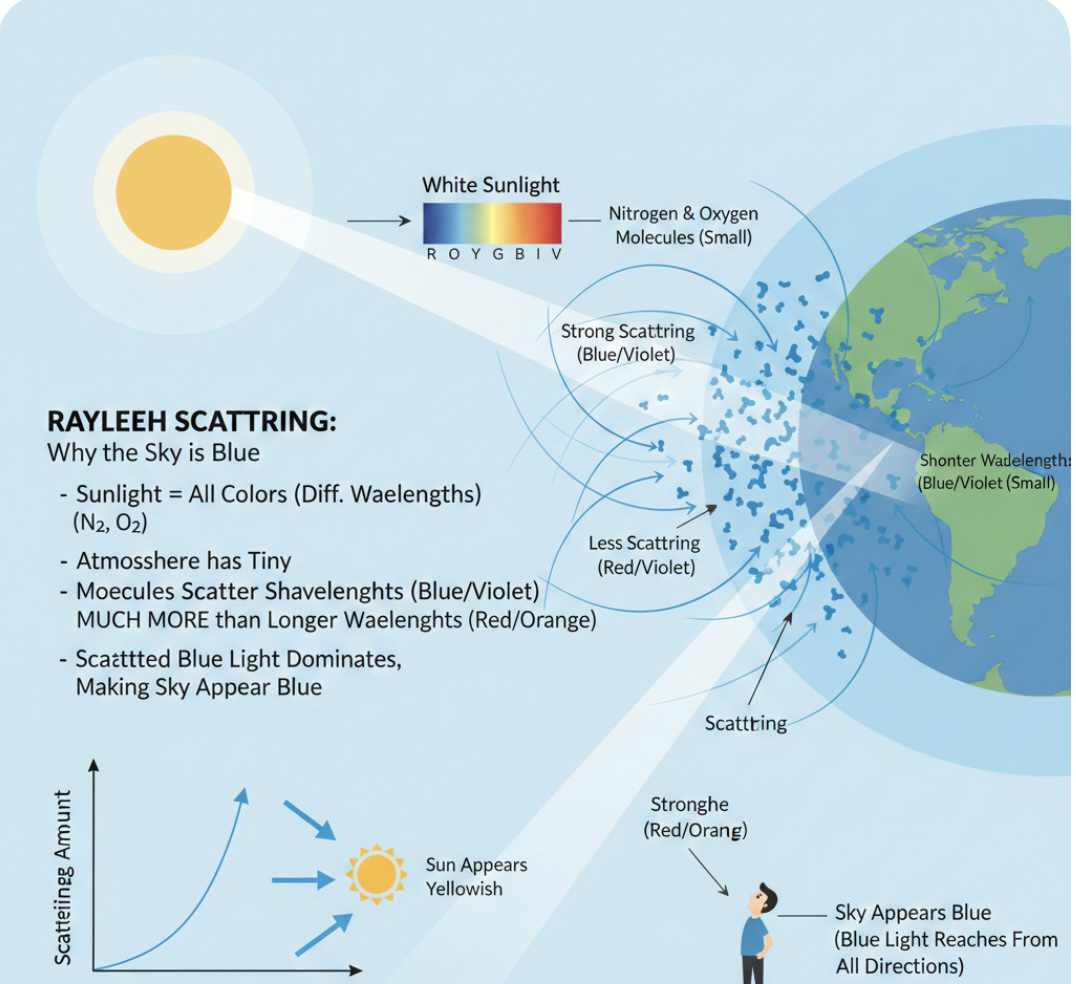
Sunlight, which we perceive as white, is actually a mixture of all colors in the visible spectrum—red, orange, yellow, green, blue, indigo, and violet—each with different wavelengths. Red light has longer wavelengths, around 700 nanometers, while blue and violet have shorter ones, about 400-450 nanometers.
When sunlight enters Earth’s atmosphere, it encounters tiny molecules of gases like nitrogen and oxygen, which are much smaller than the wavelengths of visible light. These molecules scatter the incoming light in all directions, but not equally. The amount of scattering is inversely proportional to the fourth power of the wavelength—meaning shorter wavelengths scatter much more intensely than longer ones. So, blue light scatters about 10 times more than red light.
As a result, when you look up at the sky during the day (not directly at the sun), you’re seeing sunlight that’s been scattered multiple times by the atmosphere. The blue light reaches your eyes from every direction, overwhelming the other colors and making the sky look blue. Violet scatters even more, but our eyes are less sensitive to it, and some gets absorbed higher up, so blue dominates.
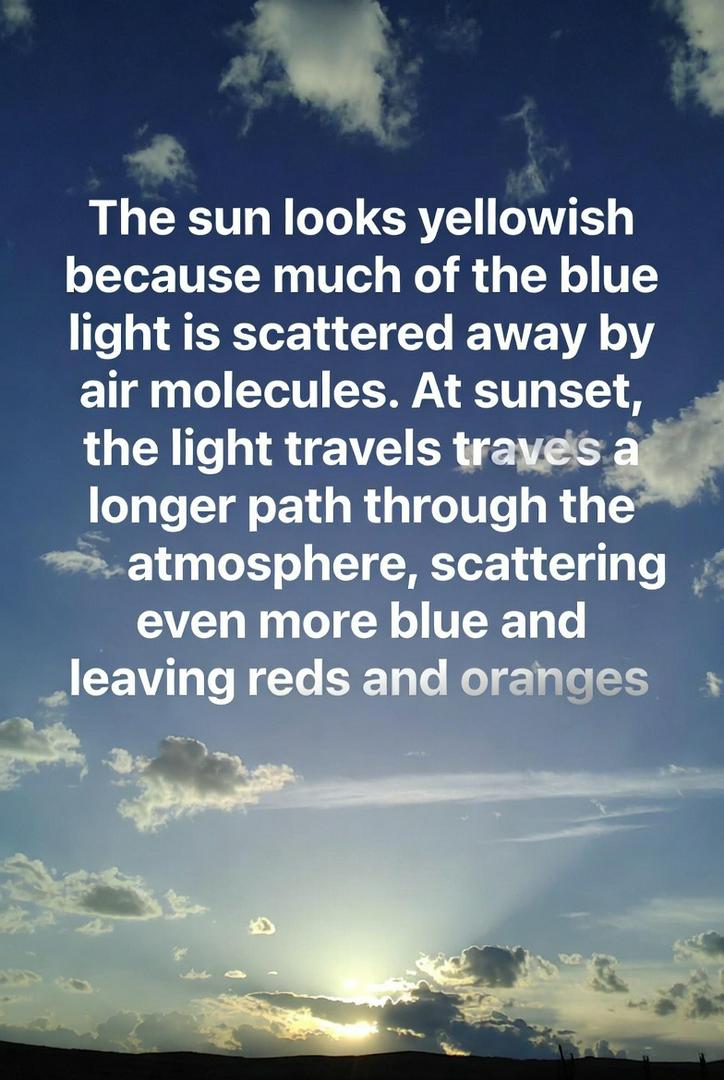
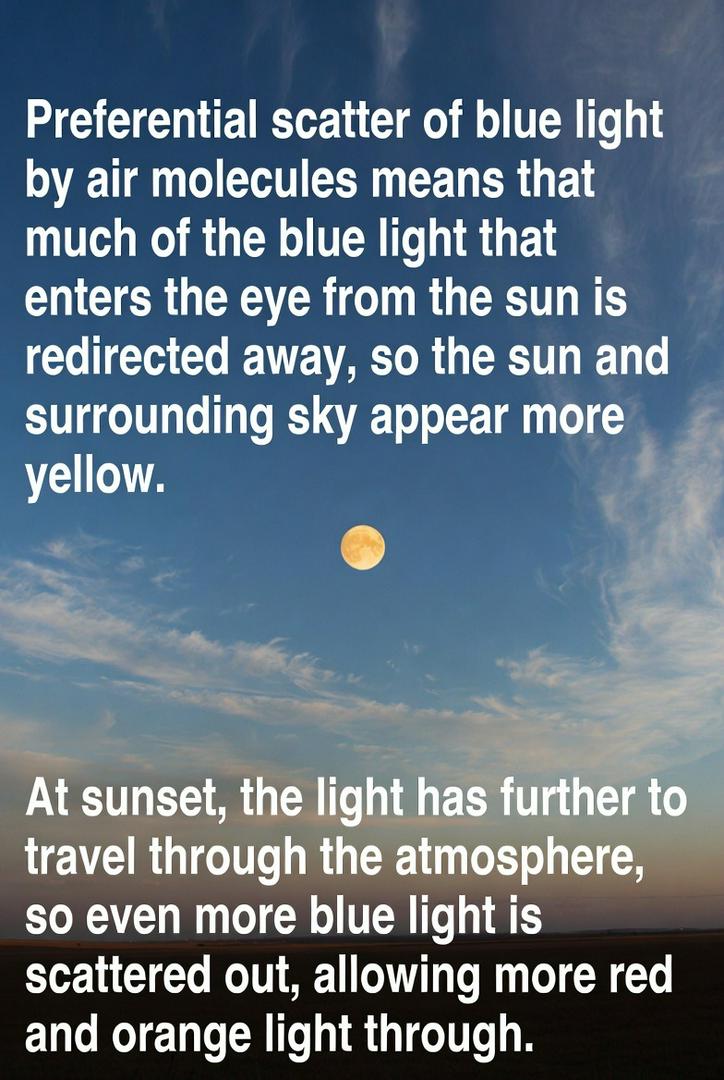
This scattering also explains why the sun looks yellowish—much of the blue has been redirected away. At sunset, the light travels a longer path through the atmosphere, scattering even more blue and leaving reds and oranges. But for the daytime sky, it’s all about that preferential blue scatter. #Optics #BlueSky #RayleighScattering #STEM #LightSpectrum
Latoshia Fisher Blunt