Tag Page LataraSpeaksTruth

#LataraSpeaksTruth
LataraSpeaksTruth

The Truth About SNAP Benefits

Let’s be real, SNAP keeps millions of Americans from going hungry. For some, it’s survival. For others, it’s a lifeline when life gets rough. But every time food stamps come up, somehow the conversation turns into an attack on Black folks… like we’re the face of poverty in America. Here’s what they don’t want to talk about: the majority of people who receive SNAP benefits are white. Always have been. Yet society loves to point the finger at the Black community as if we’re the only ones struggling. That’s not just ignorance, it’s propaganda that’s been passed down for generations. Now, let’s not act like the system’s perfect. Sure, there are people who abuse it, but fraud doesn’t have one face. It comes in all shapes, shades, and income levels. Blaming one race for a nationwide problem is just lazy thinking. Needing help doesn’t make you lazy. It makes you human. And anybody who needs SNAP should get it… without shame, without judgment, and without being turned into a stereotype. The real issue isn’t who’s getting help, it’s why the system still treats poverty like a moral failure instead of a national responsibility. #SNAPBenefits #FoodStamps #Truth #LataraSpeaksTruth #Equality #RealTalk #BreakingStigma #SNAPLife #SNAPTalk

The Truth About SNAP Benefits
LataraSpeaksTruth

The Psychology of Projection and Inherited Guilt

They hate the light because it shows the dust, the fingerprints of history on their hands. They say, “That wasn’t me,” but the silence screams louder than any confession ever could. They see someone happy, whole, and free, and feel a sting they can’t explain. Because peace, to the broken, feels like mockery, and truth, to the guilty, burns like flame. So they project… they throw their shame like stones, build walls out of denial, and call it “defense.” They inherit guilt like a family heirloom, polished with pride and passed down quietly, generation after generation, never asking why it still fits. You hold up a mirror, and they call it an attack. But the reflection isn’t the problem… it’s the refusal to look back. All it would take is one honest breath. To say: “That was wrong. That’s not who we are.” But pride is a stubborn parasite, and hate is its host. Still, truth waits. It doesn’t need revenge, it just needs space to breathe. Because healing begins where excuses end. #ThePsychologySeries #ProjectionAndGuilt #EmotionalAwareness #HealingThroughTruth #LataraSpeaksTruth #DeepThinkPieces #MirrorOfHumanity #AccountabilityOverDenial #BreakingTheCycle #UnlearningHate

The Psychology of Projection and Inherited Guilt
LataraSpeaksTruth

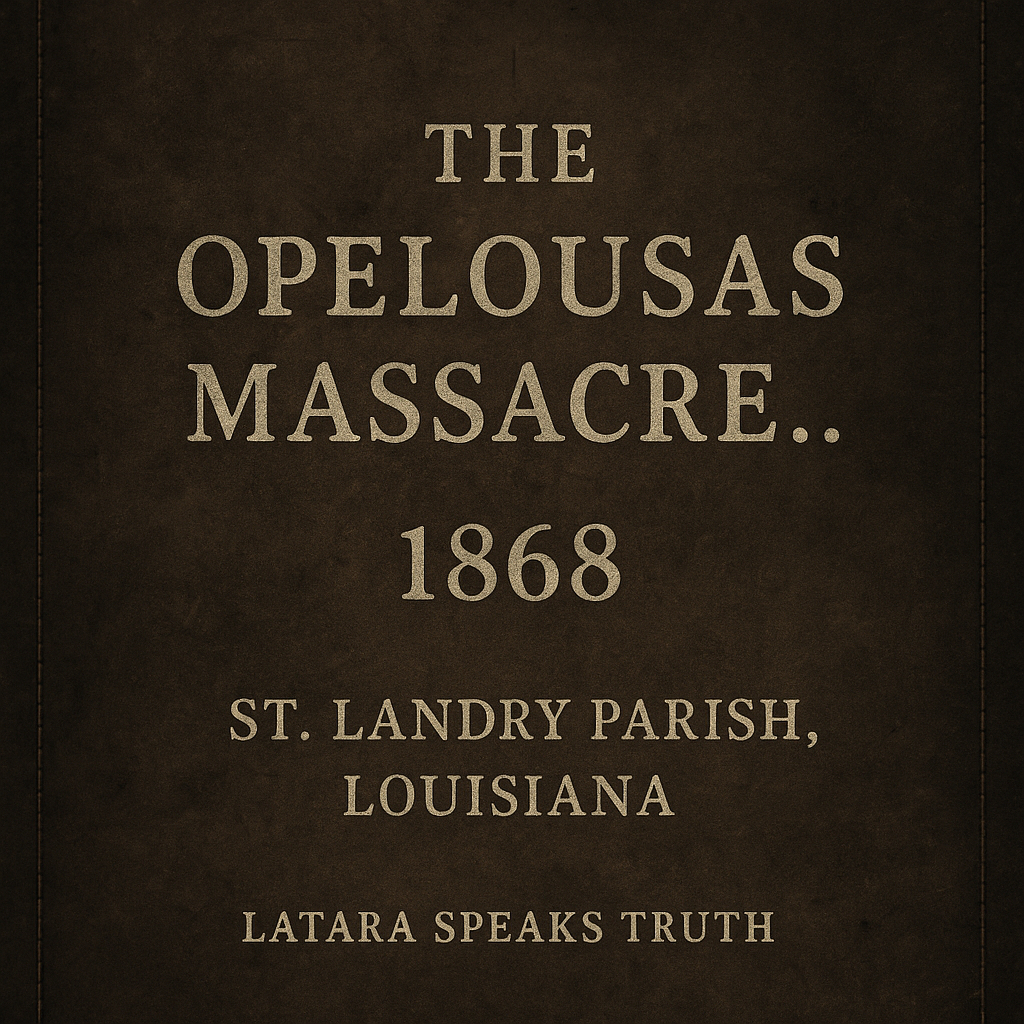
The Opelousas Massacre… The Story They Tried to Erase

On September 28, 1868, the town of Opelousas, Louisiana showed the world exactly how far white supremacy was willing to go to silence Black voices. One Black newspaper editor, Emile Deslondes, challenged the violence and intimidation Black voters were facing. Instead of answering with truth, local white Democrats answered with guns. What followed wasn’t a “riot.” It was a wave. White mobs spread across Opelousas and nearby parishes, dragging Black men out of their homes, hunting down schoolteachers, community leaders, and anyone connected to the Republican Party. It became open-season on Black life. Historians estimate that 200 to 300 Black people were murdered in just a few days… and that’s only what was documented. Many families were never counted. Records vanished. Testimonies disappeared. Louisiana buried this story the same way it buried the bodies… fast, deep, and quiet. The message was loud: “Vote if you want to… but you won’t live to see the next sunrise.” That was the blueprint for voter suppression in the Deep South. Not laws… violence. Not debates… massacres. Opelousas wasn’t a moment. It was a warning. And every time we tell the truth about it, we undo one more piece of the silence they tried to build. History isn’t just dates… it’s accountability. And this one deserves to be spoken out loud. #OpelousasMassacre #LouisianaHistory #HiddenHistory #ReconstructionEra #BlackHistoryMatters #ReclaimTheRecord #HistoryTheyDidntTeachUs #TruthOverSilence #LataraSpeaksTruth

The Opelousas Massacre… The Story They Tried to Erase
LataraSpeaksTruth

Remembering the Gettysburg Address

On November 19, 1863, President Abraham Lincoln stood on the battlefield at Gettysburg and delivered a message that reshaped how the nation understood the Civil War. The ceremony was meant to honor the thousands of soldiers who died there, but Lincoln used the moment to remind the country what the fight was really about. In just a few sentences, he connected the war to the country’s earliest promise that all people are created equal, and he challenged Americans to keep working toward a future where that promise actually means something. The speech was short, but the impact has lasted generations. Lincoln said the world would not remember what was said that day, but the opposite became true. The Gettysburg Address became a reminder that freedom, sacrifice, and democracy require constant work. Even now, the words push us to think about what kind of nation we want to be and whether we’re living up to the ideals we claim to stand on. #HistoryMatters #GettysburgAddress #OnThisDay #AmericanHistory #LataraSpeaksTruth

Remembering the Gettysburg Address
LataraSpeaksTruth

The First Black Heisman Winner… Ernie Davis Makes History (1961)

In 1961, Ernie Davis changed the entire landscape of college sports without raising his voice or asking for permission. Syracuse University’s star running back became the first Black athlete to win the Heisman Trophy… and that moment hit a lot harder than a highlight reel. Davis was one of those players who made the game look easy. Smooth balance, impossible strength, and the kind of vision that made defenses question their life choices. But behind all that talent was a young man pushing through barriers that had been in place for generations. College football was still wrestling with segregation and resistance, and a lot of doors were never meant to open for athletes who looked like him. Yet he walked right through them. His Heisman win wasn’t just about statistics or a shiny award. It was a shift… a crack in a wall. Davis stood on that stage in New York City representing every player who had been told “not yet” or “not here.” He was drafted first overall into the NFL, but leukemia took his life before he could ever take the field. He was only 23. Even so, his story didn’t fade. Syracuse retired his number, and generations of players still see him as proof that purpose shows up even when the world tries to look away. Today, his legacy still stands tall: talent, dignity, and impact that reaches far past the field. #ErnieDavis #Heisman #SportsHistory #BlackAthletes #OnThisDay #LataraSpeaksTruth

The First Black Heisman Winner… Ernie Davis Makes History (1961)
LataraSpeaksTruth

Cathay Williams was born in September 1844 in Independence, Missouri, to an enslaved mother and a free father. Because her mother was enslaved, Cathay was also born into slavery. As a young woman, she was forced into labor for Union troops during the Civil War, working as a cook and washerwoman and traveling with the army through parts of the South. That experience brought her close to military life long before she officially entered it. After the war, Williams chose a path few women of her time could even imagine. On November 15, 1866, she enlisted in the United States Army in St. Louis under the name William Cathay. Since women were barred from military service, disguising herself as a man was the only way she could join. She served in Company A of the 38th U.S. Infantry, one of the African American regiments created after the Civil War and later tied to the legacy of the Buffalo Soldiers. For nearly two years, she performed the duties expected of any soldier. Her secret remained hidden until repeated illness and hospital visits led army doctors to discover she was a woman. She was discharged on October 14, 1868. Years later, Williams applied for a military disability pension, describing her service and failing health, but her claim was denied. Much of her later life remains unclear, but her place in history does not. Today, Cathay Williams is remembered as the only documented woman known to have served as a Buffalo Soldier and one of the most remarkable women in American military history. #OurHistory #CathayWilliams #BuffaloSoldiers #MilitaryHistory #BlackHistory #WomensHistory #AfricanAmericanHistory #HiddenFigures #AmericanHistory #LataraSpeaksTruth

LataraSpeaksTruth

Happy Birthday Chamillionaire Born November 28, 1979

On this day we celebrate Hakeem “Chamillionaire” Seriki, the Houston artist who made the world lean into Southern rap with a style that was sharp, smooth, and always ahead of its time. Rising out of the Texas mixtape scene, he helped shape the sound of mid 2000s hip hop through hard work, originality, and an unapologetically smart approach to music and business. Long before “Ridin’” became a global anthem, Chamillionaire was already building a loyal fanbase with his lyrical talent and business hustle. When that record hit, it did more than earn a Grammy. It marked a moment when Southern artists were breaking every wall and proving they belonged at the center of the culture. Chamillionaire took that moment and built something lasting from it. What makes his story stand out is the way he refused to stay boxed into just the music industry. He stepped into tech before it was trendy, investing in startups, advising companies, and opening doors for other Black creatives and entrepreneurs. While a lot of artists were chasing headlines, he was quietly learning how the future was moving and positioning himself right in the middle of it. His business reputation is respected because it’s built on discipline, knowledge, and the same creativity he poured into his music. Chamillionaire showed what it looks like when an artist refuses to let the industry define them. He turned his success into access, his access into strategy, and his strategy into long term stability. Today we honor more than a rapper. We honor a visionary, a businessman, a Houston legend, and a reminder that success does not always have to be loud to be powerful. Happy Birthday Chamillionaire. Your impact reaches way beyond the charts, and the culture sees you. #Chamillionaire #HappyBirthday #HipHopHistory #HoustonLegend #Ridin #MusicCulture #LataraSpeaksTruth

Happy Birthday Chamillionaire
Born November 28, 1979
LataraSpeaksTruth

Rosa Parks Attends the Dexter Avenue Meeting, 1955

1955… Montgomery was already on edge, but that night at Dexter Avenue Baptist Church, things shifted. Rosa Parks walked into a packed mass meeting to hear a talk about Emmett Till… the 14-year-old boy whose brutal murder had shaken the entire country. The church was filled with tension, grief, anger, and a rising sense that silence was no longer an option. Parks sat and listened as speakers talked plainly about the dangers Black families faced across the South. Emmett Till wasn’t a headline to her… he was a warning, a wound, and a reminder of every injustice people tried to swallow just to survive. The stories that night weren’t meant to scare anyone… they were meant to wake everyone up. And Rosa heard all of it… really heard it. She wasn’t some tired seamstress like people love to repeat. She was seasoned, sharp, and fully aware of how dangerous the world around her was. That meeting settled something inside her spirit. It fed the backbone she already had. So when she refused to give up her seat just a few months later, it wasn’t random, it wasn’t sudden, and it definitely wasn’t because she was “just tired.” She was tired of abuse, tired of the disrespect, tired of a system that stole sons like Emmett Till and told mothers to accept it. That night at Dexter wasn’t a footnote… it was fuel. #OnThisDay #HistoryMatters #LataraSpeaksTruth #RosaParks #EmmettTill #Montgomery

Rosa Parks Attends the Dexter Avenue Meeting, 1955
LataraSpeaksTruth

The Eutaw Riot – October 25, 1870

In Eutaw, Alabama, a public gathering of Black citizens met in the courthouse square during the Reconstruction era to discuss upcoming elections and community progress. Tensions in the area had been rising, and the event turned tragic when conflict broke out between white and Black residents. Historical accounts report that several people lost their lives and many were injured. In the days that followed, voter turnout among Black citizens fell sharply due to widespread fear and intimidation. This shift helped change the political outcome in Greene County, marking a major setback for Reconstruction efforts in Alabama. The Eutaw Riot became one of the most notable examples of how resistance to racial equality influenced Southern politics after the Civil War. It stands as a reminder of how fragile progress can be when unity gives way to fear. #BlackHistory #EutawRiot #ReconstructionEra #AmericanHistory #LataraSpeaksTruth

The Eutaw Riot – October 25, 1870
Tag: LataraSpeaksTruth - Page 8 | LocalAll