1/1

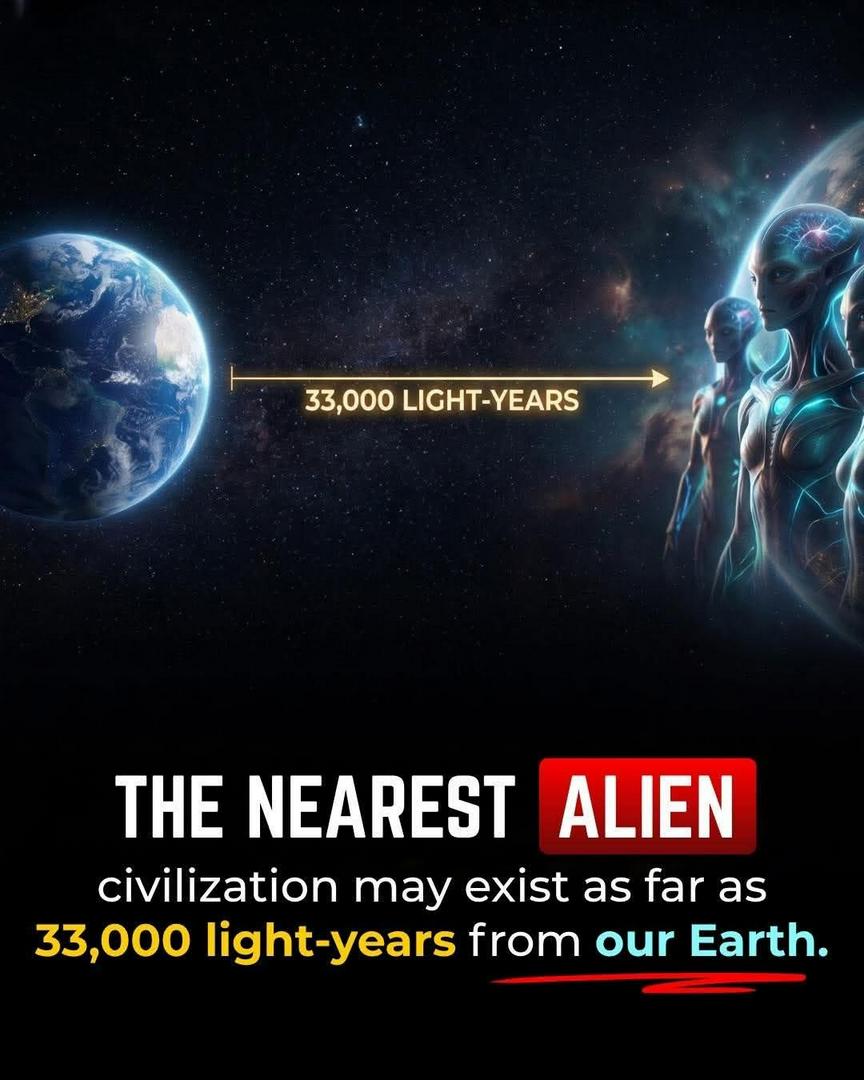
🚨The Milky Way may contain many habitable planets, but advanced civilizations could be incredibly far apart. A new study suggests that if other technological civilizations exist in our galaxy, the nearest one could be roughly 33,000 light-years away from Earth. ⸻ 🌍 What the researchers studied Scientists examined how long planets can maintain complex, life-supporting environments. Their models focused on worlds with: • Oxygen-rich atmospheres • Active plate tectonics • Long-term climate stability These factors are considered important for the evolution of complex life and technology. ⸻ ⏳ A timing problem One of the biggest challenges is that civilizations must exist at the same time. On Earth, technological civilization appeared only after about: • 4.5 billion years of planetary evolution If intelligent species are rare and short-lived, the chances of two civilizations overlapping in time become very small. ⸻ 🌠 What they found The study suggests that for multiple technological civilizations to coexist in the Milky Way, many would need to survive for hundreds of thousands—or even millions—of years. Otherwise, vast distances and different evolutionary timelines make contact unlikely. ⸻ 🔭 Why it matters The findings do not rule out extraterrestrial intelligence. Instead, they highlight how difficult it may be for civilizations to find each other across a galaxy containing hundreds of billions of stars. ⸻ ✨ Simple takeaway: The Milky Way may host other intelligent civilizations, but they could be separated from us by tens of thousands of light-years and vast spans of time. ⸻ 📄 Research Paper Scherf & Lammer, “How Common Are Biological Extraterrestrial Intelligent Species in the Milky Way?”, presented at EPSC-DPS 2025 (2025).
3 days ago

Shawn
Why do you want to find other intelligent beings in the vastness of space and time.
We developed and invested in weapon systems throughout human history just to kill our own kind, just imagine if an alien civilization had technology to reach Earth, that would be end of Earth as we know it..
2d
Plano, TX
Reply(1)

John Usher
After watching science fiction movies for years I can see that the predominant language in the universe is english!
2d
Joyce, WA
Reply

Ends Times
NASA VOYAGER 1 is steadily looking for a contact! 16 billion miles away and counting.
3d
Lapeer, MI
Reply

Carlos Soto
there is life out there ..... it's called heaven.

2d
Harrisburg, PA
Reply

checkmate
they need to leave them aliens alone
2d
Reply
More comments ...
write a comment...