1/1

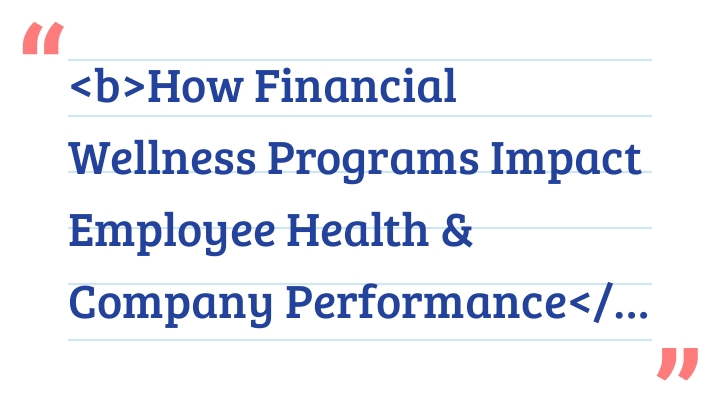
<b>How Financial Wellness Programs Impact Employee Health & Company Performance</b> <img src="https://i.ibb.co/SqYBXMK/IMG-20260528-WA0012.jpg" width="600" /> <img src="https://i.ibb.co/VGP2k9P/IMG-20260528-WA0013.jpg" width="600" /> A good program on paper means little if few employees use it. Thus, engagement metrics are often the first and most telling measure of effectiveness of a <a href="https://www.yourmoneyline.com/"> financial wellness program</a>. <img src="https://i.ibb.co/Qj9HkKDF/IMG-20260528-WA0014.jpg" width="600" /> One of the compelling promises of financial wellness is that reducing money stress can improve health outcomes and reduce absenteeism. Research by the <a href="https://www.consumerfinance.gov/"> U.S. Consumer Financial Protection Bureau</a> highlights that financial distress is tied to lower productivity, increased absenteeism, and impaired health outcomes. <img src="https://i.ibb.co/1fR0p2TG/IMG-20260528-WA0015.jpg" width="600" /> <img src="https://i.ibb.co/fdQdprrh/IMG-20260528-WA0016.jpg" width="600" /> <img src="https://i.ibb.co/M57zSJ2j/IMG-20260528-WA0017.jpg" width="600" /> <img src="https://i.ibb.co/7xw0dZBS/IMG-20260528-WA0018.jpg" width="600" /> <img src="https://i.ibb.co/FbvcSjZd/IMG-20260528-WA0019.jpg" width="600" /> <img src="https://i.ibb.co/sv32W7M3/IMG-20260528-WA0020.jpg" width="600" />
6 days ago
write a comment...