1/1

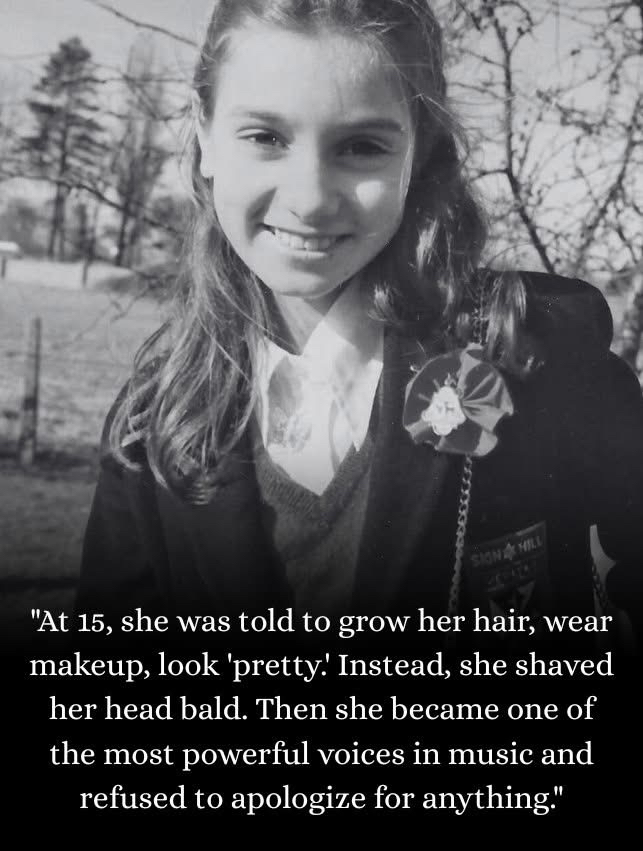
At 15, she was told to grow her hair, wear makeup, look "pretty." Instead, she shaved her head bald. Then she became one of the most powerful voices in music—and refused to apologize for anything.Dublin, Ireland, 1966.Sinéad O'Connor was born into a Ireland that was Catholic, conservative, and deeply conflicted.Her childhood was brutal.Physical abuse. Emotional trauma. A mother who hurt her. A system that failed her.By age 15, she'd been placed in a Magdalene asylum—institutions where "troubled" Irish girls were sent to be reformed, punished, and hidden away.But in that darkness, Sinéad found the one thing that made sense: music.A nun at the asylum noticed her voice. Arranged for her to have lessons.And slowly, Sinéad began to understand that her voice—literally and metaphorically—was her way out.When she was finally released, she joined a band called Ton Ton Macoute. The music industry took one look at her and had notes.Lose weight. Grow your hair long. Wear dresses. Smile more. Look feminine. Be marketable. Sinéad's response?She shaved her head.Completely bald.In 1987, when female pop stars were Cindy Lauper and Madonna—big hair, bold makeup, carefully crafted images—Sinéad O'Connor appeared with a shaved head, ripped jeans, and combat boots.No apologies. No explanation. No compromise.Her debut album, "The Lion and the Cobra," dropped that same year.Critics didn't know what to do with it.It was raw. Angry. Vulnerable. Powerful.Irish traditional music mixed with punk aggression and alternative rock.A woman's voice—not trying to be pretty or palatable—just furiously, desperately honest.Songs about abuse. About anger. About surviving. About refusing to be broken.The album went gold. But Sinéad wasn't interested in playing the game.Then came 1990 and "Nothing Compares 2 U."The song—written by Prince—
2026-01-14
Anne Smith
Sinead O’Connor was a great singer.😲
01-15
Lawton, OK
Reply(7)
57

Rita Christensen
If you've never been Abused, You Don't Have A Clue!!!
01-15
Jamestown, NY
Reply(1)
27

Sarah Zweydoff
She was a rebel with a cause. Misunderstood, but beautiful voice💕
01-14
Pembroke, KY
Reply
25
janice
There’s no right or wrong in living our lives as a woman unless we hurt or kill another person.
We are all a precious miraculous living being. Do the best we can according to our own particular desires needs and expressions.
01-17
Los Angeles, CA
Reply(5)
20

Midge Carew
She spoke her truth! God loves her 🙏🏼🌸💕👍🏼
01-15
Boulder Creek, CA
Reply
23

Karen Dahlquist
Tremendously talented. So very sad that she couldn’t find peace in her lifetime. A tremulous life💕I’m hoping that her soul is a peace.
01-17
Turtle Lake, WI
Reply(1)
21

William Fredericks

01-14
Pottsville, PA
Reply(3)
17

Lissa
She had 1 album with 1 decent song 🙄
01-15
Bella Vista, AR
Reply(9)
11

Brandy Moore
She had a beautiful voice. I loved her music when I was growing up!
01-16
Fulton, MS
Reply
16

Sybille Crom
She was Real !
01-14
Spring Hill, FL
Reply
15
More comments ...
write a comment...