1/1

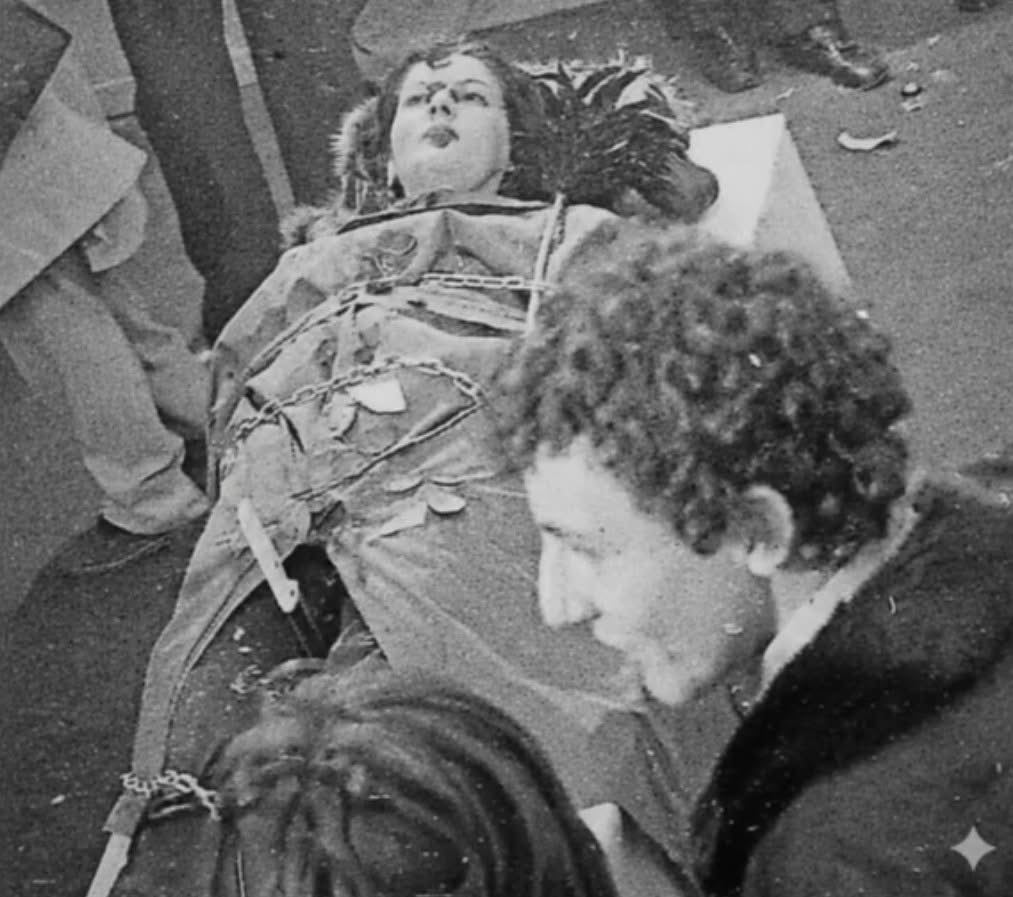
In 1974, inside a gallery in Naples, Italy, performance artist Marina Abramović did something no one was ready for. She stood completely still. Silent. Unmoving. On a table beside her were 72 objects. Some harmless: a rose, perfume, bread. Some dangerous: scissors, chains, a scalpel… and a loaded gun. A sign read: “You may use any object on me. I will not resist. I take full responsibility.” For six hours, she became an object. At first, the crowd was gentle. Someone placed a flower in her hand. Someone kissed her cheek. Then something shifted. Clothes were cut away. Skin was scratched with thorns. Blood appeared. People stopped seeing her as a person. Someone sliced her neck just to watch it bleed. Another person took the gun, placed it in her hand, and pointed it at her own head. Others had to intervene to stop it from ending right there. Marina didn’t react. Didn’t cry. Didn’t move. She let the crowd decide how far they were willing to go. When the six hours ended, she stepped forward. Alive. Bleeding. Human again. And that’s when the crowd broke. People ran. Avoided her eyes. Unable to face what they had done. The performance was called Rhythm 0. It was never repeated. Not because it failed— but because it proved something terrifying: When responsibility is removed… when permission is given… ordinary people are capable of extraordinary cruelty. And all it takes is silence.
2026-01-01

Matt Johnson
Marina would be a perfect Democrat. Performance art is what the Democrat party is all about.
01-01
Riverside, CA
Reply(48)
56
herquietsails
You guys missed it. It’s not America. It’s not Country specific or politics specific. It’s ordinary people regardless of location, status, race or religion.
Going forward, the message is simple but uncomfortable:
Do not wait for rules to tell you what is right.
Do not confuse silence with neutrality.
Do not assume someone else will intervene.
Humanity is preserved not by intention, but by action.
01-01
Memphis, TN
Reply(11)
86

YellowRose OfTexas
Unfortunately, you all missed the point🤔 what that teaches you is that when people are silent and non-resistant they can use any and all weapons around you in a good way or a bad way but once they start noticing, nothing happens when you’re doing anything a good way or the bad way; they begin to choose only the bad way. Basically what’s going on in our country right now when you have no responsibility or accountability for one’s actions and the people are silent. No one saying anything or standing up for what is right; chaos and death will follow.🤔 chew on that for a little while.🥰💕🥰
01-02
San Antonio, TX
Reply(7)
59

Theresa Wintermantel
This woman was a satanic witch. She was heavily involved with politicians in the democrat party. Podesta and Clintons attended her events.
01-01
Wilmington, DE
Reply(28)
40

Bright
Like in America, when your leadership has not morals or decency same can happen
01-01
Reply(13)
44

Miller Rachel
Sounds like Trump dosent care who he hurts
01-01
Hockley, TX
Reply(13)
30

Christine Dowling-Berns
I believe the experiment was to check how people will act when their is no consequences for acting on their individual instincts and desires OF good or evil- check how far they will go - who have strong self worth and integrity, while others will use the opportunity to act with violence and menace - their deepest desires or hidden feelings surface - when it’s ok to be selfish and abuse the vulnerability of another HUMAN being for self satisfaction and gratification. EXPOSE their hidden mindset when they left to be themselves.
01-02
New York City, NY
Reply(1)
24

Sonya Gentry
why dose everything turn into politics this has nothing to do with what political parties someone follows it about what people choose to do right and wrong kindness and cruelty its about choices that we make when there is no accountability it's about human nature
01-03
Hamburg, AR
Reply(3)
19

Denise Arment
oh jeez, someone is attempting to make a point and someone else just has to shift the whole idea and sarcastically try to make it political when it's not, it's a human nature subject. can't you guys stay on topic for once so we could actually have an intelligent discussion, on the topic intended 🤔 please.
01-02
Casselberry, FL
Reply
18

Sidneychambers
This isn’t about party lines,it’s a statement about humanity or lack of. Which category would you choose? I pray I. Would keep my humanity.
01-02
Dorchester Center, MA
Reply(1)
15
More comments ...
write a comment...